How Can You Tell Where a Roof Leak Is Really Coming From?
A damp patch on a ceiling can make a roof leak appear relatively straightforward. It is natural to assume that the defect must be directly above the visible water mark. In reality, roof leaks are often considerably more difficult to trace. Water can enter through one part of the roof, travel along roofing materials or structural components, and only become visible some distance away from the original entry point.
Finding the true source is therefore one of the most important parts of an effective roof repair. For homeowners in Rothwell, Northamptonshire, KJI Roofing Rothwell provides professional roof inspections and repairs designed to identify the underlying defect rather than simply treating the area where moisture happens to appear indoors.
Why Is the Source of a Roof Leak So Difficult to Find?
Water does not necessarily travel vertically from the roof covering to the ceiling below.
Once it enters the roofing system, it can follow the easiest available route. Depending on the roof construction, moisture may travel along underlay, battens, rafters or other surfaces before eventually dripping into the roof space or reaching the ceiling.
This means there can effectively be two important locations:
- The point where water enters the roof
- The point where the water finally becomes visible
Those two points may be some distance apart.
Start with the Location of the Internal Damp
The position of an internal damp patch provides useful information, but it should usually be treated as a clue rather than proof of the leak’s exact location.
A professional inspection may consider what lies above and around the affected area, including roof slopes, junctions, valleys, chimneys, flashing and penetrations.
The pattern of the moisture can also provide information. For example, staining that appears around a particular corner or follows a roof junction may help narrow down the areas requiring closer inspection.
However, identifying the visible symptom is only the beginning of the investigation.
Slipped or Broken Tiles Can Allow Water to Enter
Damaged roof coverings are one possible cause of leakage.
Tiles or slates may become:
- Cracked
- Broken
- Displaced
- Loose
- Missing
- Poorly positioned
When the roof covering is compromised, rainwater may reach the layers underneath.
Even then, the internal damp patch may not appear immediately beneath the damaged tile. The water can travel before finding somewhere to enter the property.
A professional roofer therefore needs to consider both the visible roof damage and the route the moisture may be taking.
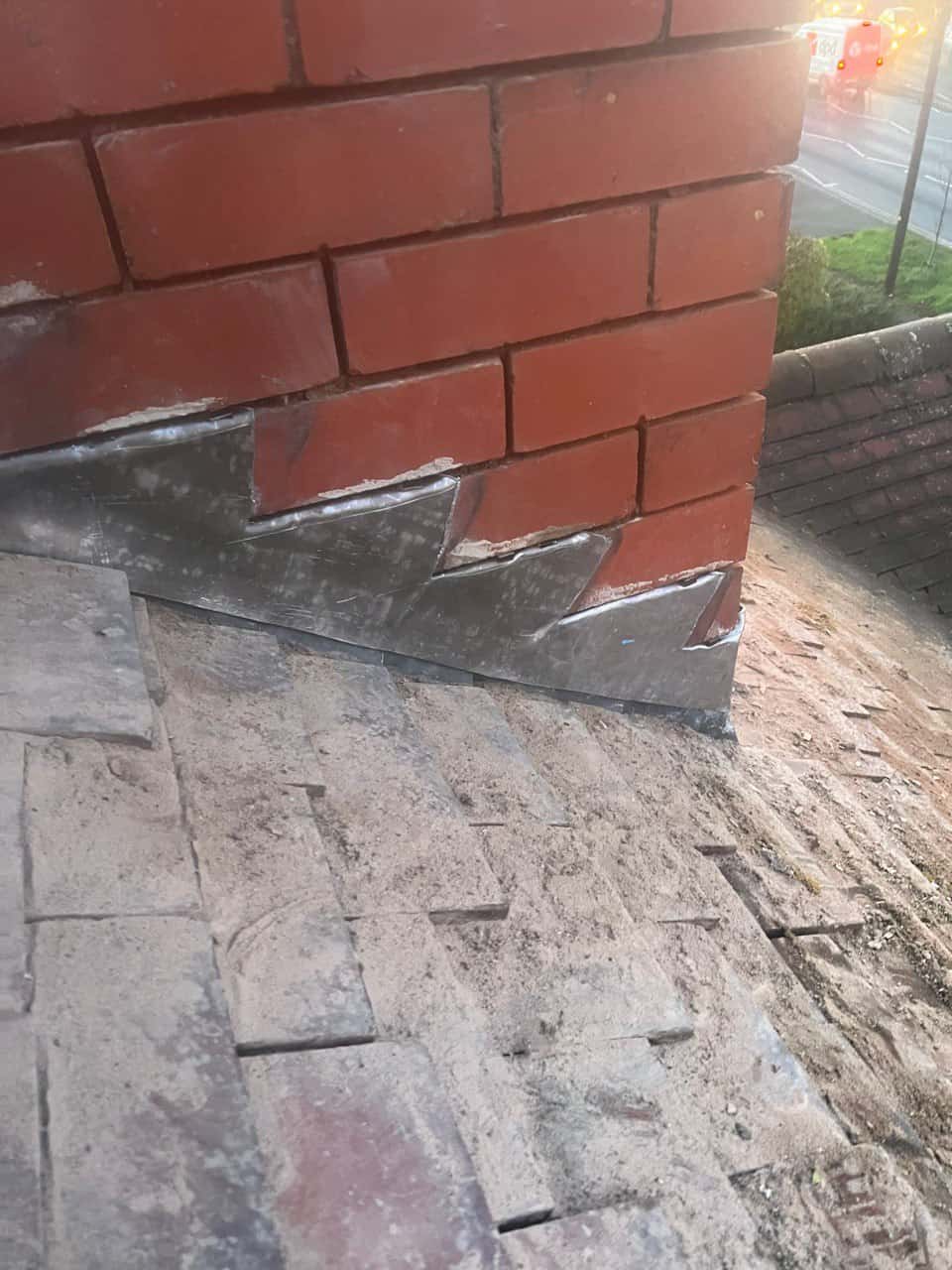
Lead Flashing Is Another Important Area to Check
Leadwork is commonly used where different parts of a roof meet, particularly around chimneys, walls and other junctions.
These areas need to remain weather-resistant despite being more complex than a straightforward roof slope.
Problems can develop if flashing becomes:
- Loose
- Split
- Displaced
- Poorly sealed at adjoining materials
- Generally deteriorated
A relatively small weakness around leadwork can allow water into the roof construction, particularly during persistent or wind-driven rain.
Because flashing often sits beside other roofing components, the resulting leak can sometimes be mistaken for a problem with the surrounding tiles.
Chimney Areas Can Make Leak Detection More Complicated
Where a chimney passes through a roof, several different materials and junctions meet within a relatively small area.
If water appears internally close to a chimney, the chimney itself may not necessarily be the only possible source.
The inspection may need to consider:
- Lead flashing
- Roofing materials around the chimney
- Junctions between different surfaces
- Mortar condition
- The route water may be taking beneath the covering
This is why simply applying material to the most obvious external gap does not always resolve a recurring leak.
The actual route of the water needs to be established.
Roof Valleys Can Carry Significant Amounts of Water
Valleys occur where two roof slopes meet and naturally channel rainwater towards the lower part of the roof.
Because they handle concentrated water flow, deterioration or obstruction within a valley can potentially result in leakage.
Problems might involve the valley material itself, adjoining roof coverings or accumulated debris affecting the way water moves through the area.
If an internal leak corresponds broadly with a valley, this area should be assessed carefully, but the complete surrounding roof still needs consideration.
Ridge and Hip Areas Can Also Develop Defects
The highest and angled junctions of a roof are exposed parts of the roofing system.
Ridge or hip tiles that become loose, damaged or displaced can leave surrounding areas more vulnerable to water penetration.
Again, the internal evidence may not appear immediately beneath the defect.
Once water passes through the external covering, gravity and the shape of the underlying construction can direct it elsewhere before it becomes visible.
Flat Roof Leaks Can Be Particularly Misleading
Finding the source of a leak in a flat or low-pitched roofing system can present its own challenges.
Water may enter through a relatively small defect and move beneath the surface before appearing internally.
Potential areas requiring assessment can include:
- Seams or joints
- Upstands
- Edges
- Roof penetrations
- Localised surface damage
- Drainage points
- Areas where water regularly collects
Looking only at the ceiling stain may therefore provide very little information about the true entry point.
The Leak May Only Appear in Certain Weather
Another useful clue is when the leak occurs.
Some leaks become noticeable during almost any rainfall, while others may only appear during particular conditions.
For example, water penetration might occur:
- During prolonged rainfall
- When rain is driven by strong winds
- After particularly heavy showers
- When water approaches the roof from a certain direction
These patterns can help indicate which roofing details may be involved.
Information from the homeowner about when the leak appears can therefore be valuable during a professional assessment.
Why a Leak Can Seem to Disappear
Intermittent roof leaks can be particularly frustrating.
A damp patch may appear during one period of rain and then remain dry during several later showers. This does not necessarily mean the defect has corrected itself.
Different rainfall intensity, wind direction and duration can change how water moves across the roof.
If a leak has appeared once, it is generally worth identifying why rather than assuming the problem has permanently disappeared.
Internal Roof-Space Inspection Can Provide Important Clues
Where the roof space is accessible, looking at the underside of the roofing system can sometimes help establish how water is travelling.
Signs may include:
- Damp timber
- Water staining
- Moisture on underlay
- Marks around roof penetrations
- Evidence of repeated water movement
However, even visible moisture within the roof space may represent part of the water’s route rather than the original entry point.
The internal and external evidence therefore needs to be considered together.
Previous Repairs Can Complicate the Investigation
Older roofs may have received several repairs during their lifetime.
Some may remain completely effective, while others can make identifying a new problem more complicated. Different materials, patched sections and historical alterations can change how water behaves once it enters the roof.
A professional inspection should consider previous work without automatically assuming that an old repair is responsible for the current leak.
The objective is to identify evidence of the present defect.
Why Guessing at the Repair Can Be Ineffective
When a leak appears, it can be tempting to repair whatever external feature looks most suspicious.
The difficulty is that an obvious-looking defect may not actually be responsible for the internal damp.
If the wrong area is treated, the leak may continue even though genuine repair work has been carried out.
Effective roof leak repairs therefore depend on diagnosis first.
The process should establish:
- Where moisture is visible internally.
- Which roofing areas could potentially feed water towards that location.
- Whether there is evidence of damage or deterioration externally.
- How water could travel through the roof construction.
- Which defect most plausibly explains the symptoms.
This systematic approach reduces the likelihood of treating symptoms rather than causes.
Does Every Roof Leak Require Major Work?
No. A visible roof leak does not automatically mean that the complete roof has failed or needs replacing.
If the cause is a localised defect and the surrounding roof remains in suitable condition, a targeted repair may be all that is required.
The important point is to determine the extent of the problem before deciding on the solution.
Where inspection reveals widespread deterioration, repeated failures or several areas of concern, more comprehensive roofing work may need to be considered. The appropriate response should reflect the actual condition of the roof rather than the size of the internal water mark.
Why Early Investigation Is Worthwhile
A relatively small leak can allow moisture into parts of the roofing system that are normally expected to remain dry.
Waiting for the internal staining to become substantially worse does not make the source easier to resolve. Instead, continued water penetration may allow the affected area to become more extensive.
Early professional investigation can help identify:
- The likely entry point
- The route moisture is taking
- The roofing components affected
- Whether the problem is localised
- The repair needed to restore weather resistance
This provides a much clearer basis for carrying out appropriate work.
Professional Roof Leak Repairs in Rothwell
At KJI Roofing Rothwell, we provide professional roofing repairs throughout Rothwell, Northamptonshire, including the investigation of difficult and recurring roof leaks.
Our approach is focused on identifying why water is entering rather than simply concentrating on where the damp patch appears inside the property. By assessing relevant roofing materials, junctions and surrounding areas, we can determine the appropriate repair for the actual defect.
Whether the problem involves tiles, slates, flashing, chimney areas or another part of the roofing system, careful diagnosis is an important first step towards achieving a dependable repair.
Conclusion
Finding the true source of a roof leak is not always as simple as looking directly above an internal damp patch. Water can enter through damaged tiles, flashing, valleys, chimney junctions or other vulnerable areas before travelling through the roof construction and appearing somewhere completely different.
That is why accurate diagnosis matters. Repairing the first visible defect without establishing the route of the water can leave the underlying cause unresolved.
For homeowners in Rothwell, Northamptonshire, KJI Roofing Rothwell provides professional roof inspections and repairs focused on finding the source of water ingress and determining the appropriate solution. If you have noticed a leak, damp patch or recurring sign of moisture, contact our team to arrange an assessment before the problem has an opportunity to develop further.
Call us on: 01536 907 192
Click here to find out more about KJI Roofing Rothwell
Click here to complete our contact form and see how we can help with your roofing needs.